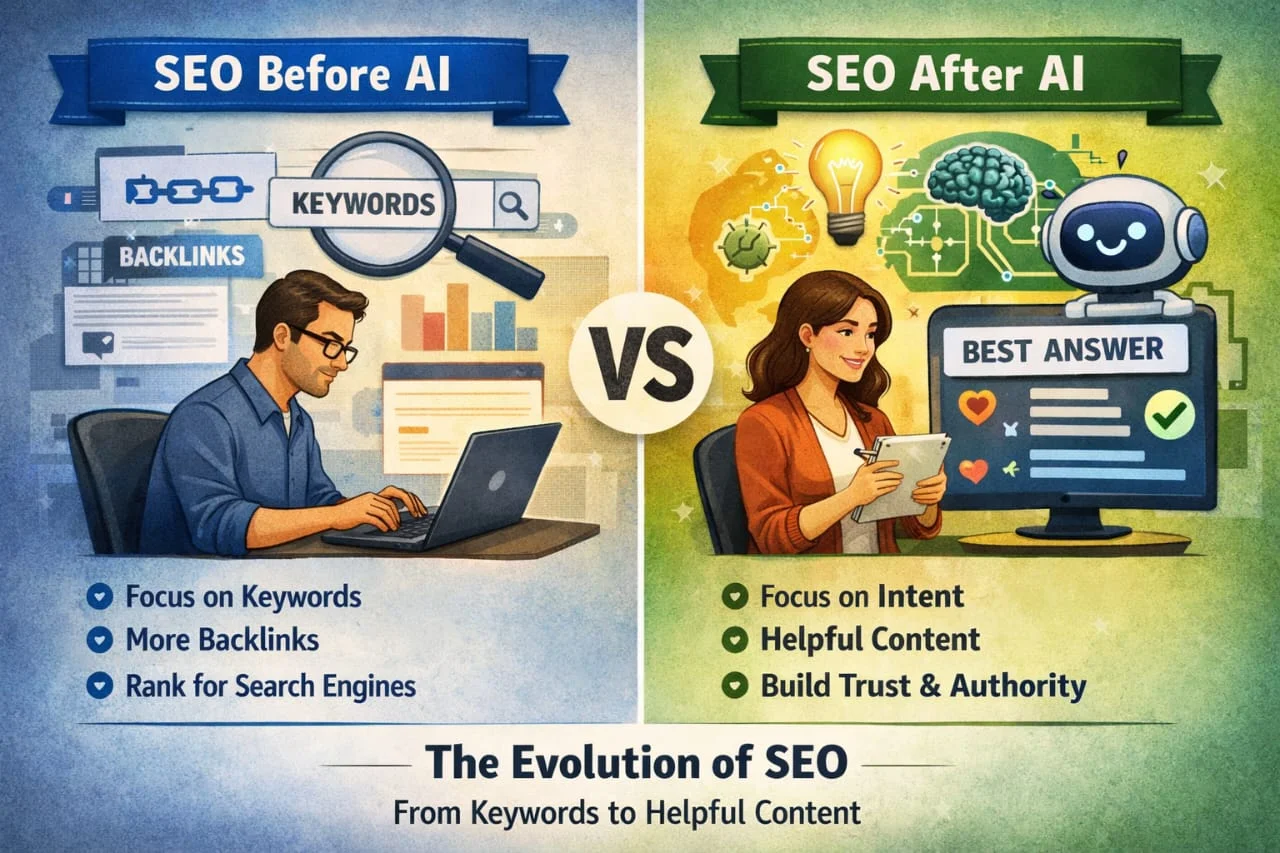
Discover how AI transformed SEO from keyword matching to intent-driven, trust-based ranking, and learn how to rank in AI Overviews and AI chats.
SEO Before and After AI: What Changed
SEO used to be simple. Not easy—but simple. If you used the right keywords, built enough backlinks, and fixed technical issues, your website could rank. That was the rule for many years.
Then AI entered search.
Today, search engines don't just find pages. They understand questions, interpret intent, and generate answers. This has completely changed how SEO works—and many businesses are still using old rules in a new world. Let's break this down in a clear, human way.
SEO Before AI: How Search Used to Work
Before AI, search engines worked like advanced matching systems.
1. Search Engines Looked for Keyword Matches
If someone searched: "best digital marketing agency" — Google looked for pages that:
- Contained that exact phrase
- Used it in the title and headings
- Repeated it enough times in the content
If your page matched well, you ranked—even if your content wasn't truly helpful.
Reality: You could rank without actually solving the user's problem.
2. Backlinks Were the Main Power Signal
Backlinks acted like votes. The more websites linking to you, the more Google trusted you. This led to:
- Link buying
- Guest posting only for links
- Focus on quantity over quality
A website with many links could outrank a better-written page.
3. SEO Was About the Search Engine, Not the User
Most SEO decisions were made by asking:
- "Will Google like this?"
- "Is the keyword density right?"
- "Did we optimize the meta tags?"
The human reading the content came second.
Why AI Changed Everything in Search
AI changed search because people changed how they search. Users no longer type: "SEO tips"
They ask: "How can I improve my website traffic without paid ads?"
AI understands:
- Meaning
- Context
- Follow-up questions
- Natural language
Search engines are now closer to human understanding, not machine matching.
SEO After AI: How Search Works Today
AI-driven search is focused on helpfulness, trust, and understanding.
1. Search Is Now About Intent, Not Just Keywords
AI doesn't just read words—it understands why someone is searching. For example:
- A beginner searching SEO wants explanations
- A business owner wants strategies and results
- A professional wants advanced insights
What this means for content:
- One keyword can have multiple intents
- Content must match the reason behind the search
- Generic content no longer works
You must ask: "What problem is the user actually trying to solve?"
2. Content Must Truly Help the Reader
AI evaluates content almost like a human would. It looks for:
- Clear explanations
- Logical flow
- Practical examples
- Complete answers
If your content feels like it was written just to rank, AI can sense that.
Helpful content:
- Explains things step by step
- Answers related questions naturally
- Feels written by someone who understands the topic
3. Experience and Trust Matter More Than Ever
AI prioritizes content that shows real experience. Not theory. Not copied ideas. Real-world understanding.
For example:
- "In our experience working with clients…"
- "We tested this strategy and saw…"
- "This approach failed for us, and here's why…"
This tells AI: this content comes from someone who actually knows.
AI Overviews: How They Really Work
AI Overviews appear at the top of Google and summarize answers. Instead of showing 10 links, Google gives:
- A direct explanation
- Key points
- References to trusted sources
Important Truth: AI Overviews don't choose pages that rank highest. They choose pages that explain best.
How to Rank in AI Overviews (Human Explanation)
1. Answer the Question Immediately
Don't make users scroll forever. Start with:
- A clear explanation
- A short summary
- A direct answer
AI prefers content that gets to the point quickly.
2. Structure Content Like a Conversation
AI reads content like a conversation: Question → Answer → Explanation → Example
Use:
- Headings that sound like questions
- Simple sentences
- Clear transitions
This helps both users and AI understand your content.
3. Be Clear, Not Clever
Clever writing is good for branding. Clear writing is better for AI.
Avoid:
- Overcomplicated language
- Buzzwords without meaning
- Long sentences with no direction
Explain things like you would to a colleague, not a robot.
Ranking in AI Chats (ChatGPT, Gemini, Perplexity)
AI chats work differently from search results. They don't rank websites—they pull trusted information.
To be included:
- Your content must be factual
- Your brand must be recognizable
- Your explanations must be consistent across the web
What AI Chats Look For
- Authority: Are you known in your space?
- Consistency: Is your message the same everywhere?
- Clarity: Can AI reuse your explanation confidently?
Brand Matters More Than Ever
SEO is no longer just about pages—it's about who you are. AI trusts:
- Known brands
- Experts
- Consistent entities
This means:
- Build your author identity
- Mention your experience
- Be visible beyond your website
Your name and brand are now ranking signals.
The Biggest Mistake to Avoid
Relying fully on AI to write content.
AI can help, but AI-only content lacks soul, experience, and depth.
Human touch matters because:
- Humans understand nuance
- Humans share mistakes and lessons
- Humans explain things with empathy
AI amplifies good content—it cannot replace human insight.
Final Thoughts: The New SEO Mindset
Before AI: "How do I rank higher?"
After AI: "How do I become the best answer?"
SEO today rewards:
- Helpfulness over hacks
- Trust over tricks
- Experience over volume
If your content helps one real person clearly and honestly, AI will notice.