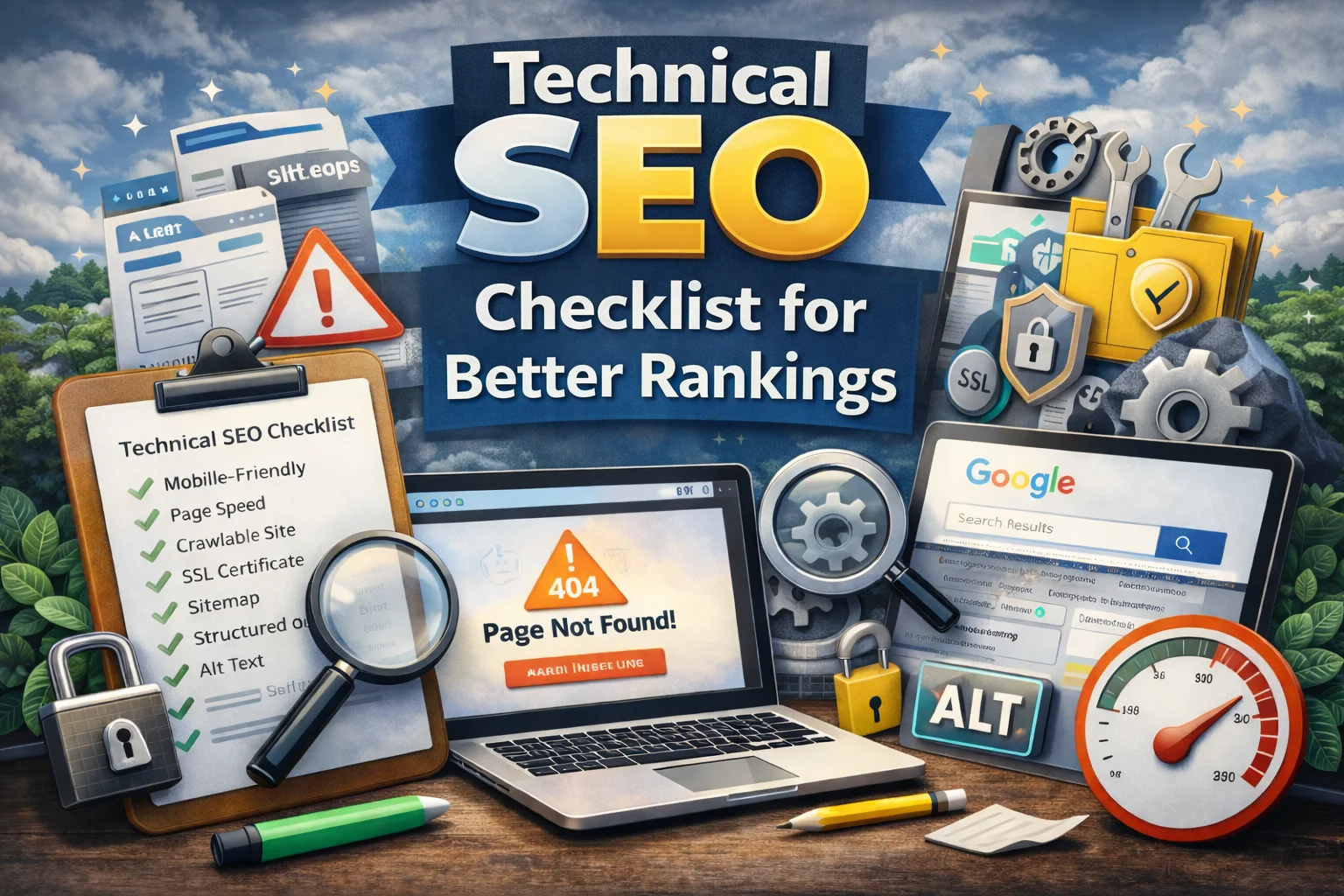
A complete technical SEO checklist covering crawlability, site speed, Core Web Vitals, mobile-friendliness, HTTPS, schema markup, and more to boost rankings.
Technical SEO Checklist for Better Rankings
Technical SEO is the backbone of any successful search engine optimization strategy. Even the best content and strongest backlinks won't perform well if search engines cannot crawl, index, and understand your website properly. This in-depth technical SEO checklist will help you optimize your site for better rankings, improved crawlability, and a stronger overall SEO foundation.
1. Website Crawlability and Indexing
The first step in technical SEO is ensuring that search engines can crawl and index your website efficiently.
Check Robots.txt File
Make sure your robots.txt file is not blocking important pages such as service pages, blog posts, or category pages. Avoid blocking CSS and JavaScript files, as search engines need them to render pages correctly.
Use XML Sitemap
Create and submit an XML sitemap in Google Search Console. Your sitemap should include all important URLs and be updated automatically when new pages are added.
Fix Crawl Errors
Regularly monitor Google Search Console for crawl errors such as 404 pages, server errors (5xx), and redirect issues. Fixing these errors helps search engines access your content without interruptions.
2. Website Architecture and URL Structure
A clean and logical site structure improves both user experience and SEO.
Flat Site Structure
Keep your important pages within 2–3 clicks from the homepage. This helps search engines discover pages faster.
SEO-Friendly URLs
Use short, descriptive, and keyword-rich URLs. Avoid unnecessary parameters, numbers, or special characters.
Proper Internal Linking
Link related pages using relevant anchor text. Strong internal linking helps distribute link equity and improves indexing.
3. Page Speed and Core Web Vitals
Page speed is a confirmed Google ranking factor and a critical part of technical SEO.
Optimize Core Web Vitals
Focus on improving LCP (Largest Contentful Paint), INP (Interaction to Next Paint), and CLS (Cumulative Layout Shift).
Compress Images
Use next-gen formats like WebP and compress images without compromising quality.
Minify CSS, JavaScript, and HTML
Reduce file sizes by removing unnecessary code.
Enable Browser Caching and CDN
Use a content delivery network (CDN) and browser caching to reduce load time.
4. Mobile-Friendliness and Responsive Design
With Google's mobile-first indexing, your mobile version is the primary version considered for ranking.
Responsive Design
Ensure your website adapts perfectly to all screen sizes.
Mobile Usability Issues
Fix problems like clickable elements being too close, text too small, and horizontal scrolling.
Test with Mobile-Friendly Tool
Regularly test your site using Google's Mobile-Friendly Test.
5. HTTPS and Website Security
Website security builds trust and is a lightweight ranking factor.
Use HTTPS
Install an SSL certificate and redirect all HTTP URLs to HTTPS using 301 redirects.
Fix Mixed Content Issues
Ensure all resources (images, scripts, CSS) are loaded securely over HTTPS.
Protect Against Malware
Regularly scan your site for malware and security vulnerabilities.
6. Duplicate Content and Canonicalization
Duplicate content can confuse search engines and dilute rankings.
Use Canonical Tags
Implement rel="canonical" to specify the preferred version of a page.
Avoid URL Duplication
Handle issues caused by parameters, trailing slashes, and pagination.
Check WWW and Non-WWW Versions
Choose one version and redirect others using 301 redirects.
7. Structured Data and Schema Markup
Structured data helps search engines understand your content better and can enhance visibility through rich results.
Implement Schema Markup
Use schema types like Article, Product, FAQ, Local Business, and Breadcrumb.
Validate Structured Data
Test your markup using Google's Rich Results Test.
Enhance CTR with Rich Snippets
Schema can improve click-through rates by displaying ratings, FAQs, and other enhancements.
8. Technical On-Page SEO Elements
Technical optimization also includes important on-page SEO factors.
Optimize Title Tags
Use primary keywords naturally and keep titles within 55–60 characters.
Meta Descriptions
Write compelling, keyword-rich meta descriptions to improve CTR.
Header Tags (H1–H6)
Use a clear heading hierarchy with one H1 per page.
Image Optimization
Add descriptive alt text with relevant keywords.
9. JavaScript SEO and Rendering
Modern websites rely heavily on JavaScript, which can create SEO challenges.
Ensure Proper Rendering
Make sure important content is not hidden behind JavaScript.
Use Server-Side Rendering (SSR)
This helps search engines crawl and index JavaScript-heavy pages more efficiently.
Check with URL Inspection Tool
Use Google Search Console to see how Google renders your pages.
10. Log File Analysis and Monitoring
Advanced technical SEO involves continuous monitoring and analysis.
Analyze Server Log Files
Understand how search engine bots crawl your site.
Monitor Index Coverage
Regularly check indexed vs. non-indexed pages.
Track Technical SEO KPIs
Monitor crawl budget, page speed, Core Web Vitals, and indexation trends.
Conclusion
A strong technical SEO foundation is essential for achieving and maintaining higher search engine rankings. By following this technical SEO checklist, you can ensure your website is fast, secure, crawlable, and optimized for both users and search engines. Technical SEO is not a one-time task—it requires regular audits, monitoring, and updates. When combined with high-quality content and a solid link-building strategy, technical SEO can significantly boost your website's visibility, traffic, and overall performance in search results.